
Rwanda’s Nuclear Bet: Policy Pathways from Ambition to Investable Reality
By: Dr. Mohamed Alhaj, Founder & Managing Director of Terra Energy
Within three weeks in May 2026, Rwanda signed nuclear cooperation agreements with both the United States and Russia. That is not a hedge. It is a signal that Kigali is treating nuclear energy as a serious instrument of national energy security, not a rhetorical flourish attached to Vision 2050.
Rwanda has passed the International Atomic Energy Agency (IAEA) Phase 1 Integrated Nuclear Infrastructure Review, hosted the continent’s flagship nuclear investment summit, and secured a diversified partnership base spanning four continents. What the country has not yet built is the policy architecture that converts this momentum into financed, under-construction infrastructure rather than a well-attended series of summits.
This brief identifies three policy gaps — taxonomy, financing coordination, and project preparation — and argues that closing them is a continental priority, not only a national one. The core argument: Rwanda’s nuclear programme is currently a diplomatic and technical success. It is not yet an economic one. Closing that gap is what will determine whether it becomes bankable infrastructure, or a credential without a construction date.
1. The case has moved from ambition to procurement
The key phrase here is energy security, not energy transition.
Rwanda imports the near-totality of its petroleum over a 1,500-kilometre landlocked route. When the Middle East conflict pushed Brent crude past $112 a barrel earlier this year, the country felt it within days — in fuel prices, in transport costs, in the price of doing anything at all. That is the vulnerability nuclear power is meant to retire, not the abstraction of a 2050 decarbonisation target.
Rwanda’s institutional progress reflects that urgency.
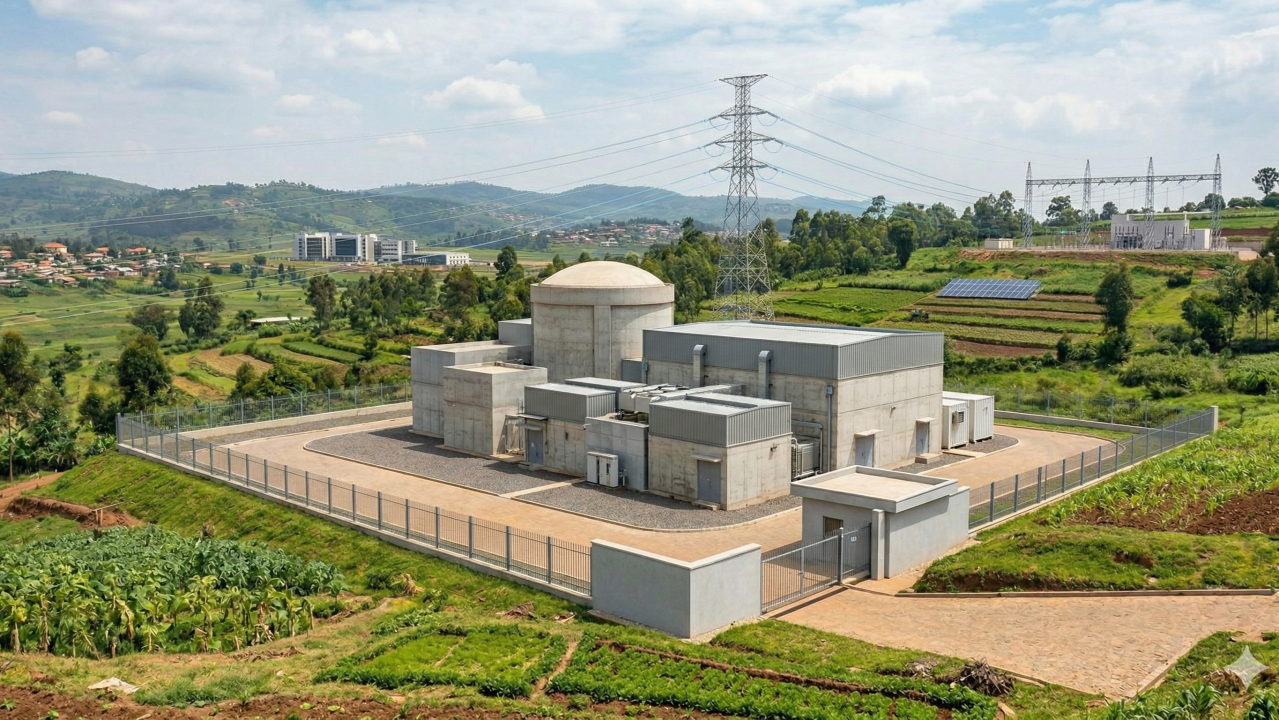
The IAEA’s Phase 1 Integrated Nuclear Infrastructure Review, completed in March 2026, confirmed the country’s readiness across regulation, safety, and institutional coordination — a result the IAEA’s own mission lead described as reflecting “a deep commitment to the programme” (IAEA, 2026). Rwanda has since moved into Phase 2. NEISA 2026, hosted in Kigali under the theme “Turning Nuclear Energy Ambition into Investable Reality,” produced a framework agreement with Holtec on its Small Modular Reactor (SMR) -300 reactor covering site planning, financing, and regulatory alignment, alongside the cooperation agreements signed with the United States and Russia.
The government’s ambition — nuclear power supplying 60–70% of the national energy mix by 2050, with the first small modular reactor operational in the early 2030s — is now backed by a diversified partnership base rather than a single vendor bet.
This diversification is deliberate, and it is a genuine point of continental leadership: Rwanda is deliberately avoiding single-source dependency at the programme’s most formative stage, keeping multiple technology, financing, and training pathways open simultaneously — including a domestic workforce build-out, with roughly 120 Rwandan students currently training in nuclear-related fields abroad. Few African nuclear entrants have matched that rigor this early.
The scale Rwanda is positioning itself for is continental in nature. The IAEA’s own outlook for the sector projects that Africa’s nuclear capacity could grow more than tenfold by 2050 under a high-case scenario compared with 2022 levels — a build-out requiring over $100 billion in investment, even as nuclear’s overall share of the continent’s electricity mix remains modest (IAEA, 2025).

Figure 1. Africa’s projected nuclear capacity growth, high-case scenario
Source: IAEA, Outlook for Nuclear Energy in Africa, 2025.
The opportunity is real; it is also, on the continent’s own numbers, a long and capital-intensive one — which is precisely why the financing architecture matters as much as the diplomacy.
But institutional readiness is not the same as a financed, under-construction plant. That gap — between a credible programme and a contracted one — is where policy now has to do the work that diplomacy has already done.
2. The financing architecture is close, but incomplete
Rwanda has built more of the financial infrastructure for green investment than almost any other country on the continent. It is one of only two African countries with a formalised Green Taxonomy, and it has stood up Ireme Invest — channelling capital through the Rwanda Green Fund and the Development Bank of Rwanda (BRD) — as the country’s largest climate-finance facility.
Nuclear is not yet included in that taxonomy. It should be.
The EU classified nuclear as a transitional sustainable activity in 2023 (European Commission, 2022). The United Nations Economic Commission for Europe (UNECE) lifecycle assessment places nuclear’s emissions intensity at 5.1–6.4 gCO₂eq/kWh — comparable to wind, and a fraction of gas or peat (UNECE, 2021). Leaving nuclear outside Rwanda’s own green classification system is not a neutral omission; it is a gateway that stays closed. Without formal inclusion, the programme cannot access green bonds or climate-aligned institutional capital on the same terms as solar or hydropower, even though its emissions profile qualifies it.
The global financing environment has also shifted in Rwanda’s favour. The World Bank lifted its long-standing ban on nuclear financing in 2025, formalising a partnership with the IAEA aimed at supporting reactor lifetime extensions and the commercial deployment of small modular reactors (World Bank Group, 2025). Export credit agencies in the US, UK, and South Korea are now actively backing SMR programmes in emerging markets, and Multilateral Investment Guarantee Agency (MIGA) guarantees can meaningfully compress the sovereign risk premium that has historically made nuclear projects in frontier markets difficult to underwrite. The instruments exist. What Rwanda does not yet have is a single coordinated financing strategy that sequences government-to-government partnerships, DFI de-risking instruments, and green capital markets access into one investable pipeline, rather than parallel, uncoordinated tracks.
The scale of that financing challenge is not abstract. World Bank Group President Ajay Banga has framed it directly: meeting developing countries’ projected doubling of electricity demand by 2035 will require annual investment in generation, grids, and storage to rise from $280 billion today to roughly $630 billion (World Bank Group, 2025).

Figure 2. Developing-country electricity investment need, 2025 vs. 2035
Source: World Bank Group, remarks by President Ajay Banga, IAEA partnership signing, June 2025.
The IAEA has identified coordinated support from multilateral development banks — the World Bank and the African Development Bank chief among them — as central to closing this gap for Africa’s nuclear entrants specifically (IAEA, 2025). Rwanda’s coordination problem is a national instance of a continental one.
3. A regional lens: ahead on preparation, not yet ahead on delivery
Rwanda is not the only African country making this bet, and the comparison is instructive rather than flattering.
Ghana has pursued a 1,000 MWe commercial plant since 2006, with vendors from the US, Russia, Canada, and South Korea cycling through consideration. Two decades later, no construction contract has been signed — a caution against mistaking vendor interest for progress. South Africa’s Koeberg plant remains the continent’s only operating commercial reactor, recently relicensed for another twenty years, with over 5 GW of additional capacity now planned. Kenya has set out plans for a 2,000 MW plant in Siaya County, with construction targeted for 2027.
Against that field, Rwanda’s institutional sequencing — regulatory groundwork, IAEA engagement, and workforce investment ahead of a construction decision — is genuinely ahead of where Kenya and Uganda stood at equivalent stages. That edge is real and worth stating plainly, rather than with false modesty.
Rwanda has also made a sequencing choice worth naming explicitly: prioritising research and isotope production ahead of grid-scale power, following the path Ghana and South Africa took with their research reactors rather than the stalled, power-first ambitions seen elsewhere on the continent. Isotope production for medical and industrial use can generate revenue and operational experience on a fraction of a full power programme’s budget, which is precisely the kind of interim bankability signal frontier-market investors look for before committing to the larger bet.
But good preparation does not mean sound delivery. Ghana’s twenty-year gap between vendor interest and a signed contract is the risk Rwanda has not yet outrun, and the one this brief’s recommendations are aimed at closing.
4. Why this belongs on the continental policy agenda
Rwanda’s nuclear programme is a national story with continental implications, and that is precisely the frame AYEF and the African Union Development Agency – New Partnership for Africa’s Development (AUDA-NEPAD) are positioned to advance.

Agenda 2063’s industrialisation pillar depends on reliable, competitively priced power at a scale intermittent renewables alone will not deliver for energy-intensive sectors — mineral beneficiation, advanced manufacturing, and the data infrastructure a digital AfCFTA economy requires (African Union, 2015; 2018).
Nuclear is not a substitute for the continent’s renewables build-out; it is the firm-power complement that industrial policy currently lacks. A green taxonomy that excludes nuclear — as most African taxonomies currently do, following Rwanda’s own gap — is a continental design flaw as much as a national one, and it is squarely within reach of the kind of policy harmonisation AUDA-NEPAD convenes.
There is also a market-scale argument.
A single country’s nuclear programme, however well-run, struggles to reach the transaction size that draws sophisticated infrastructure capital efficiently. A continental framework — shared procurement standards, pooled de-risking instruments, a common approach to green taxonomy treatment — would let Rwanda’s institutional rigor become a template other African entrants can adopt rather than relearn from scratch, and would give investors a regional pipeline large enough to justify dedicated capital, not just one-off project finance.
5. What policymakers should do next
Closing the gap between ambition and delivery starts with a classification fix, not a new policy: formally incorporating nuclear into Rwanda’s Green Taxonomy. The emissions case is already made internationally (European Commission, 2022; UNECE, 2021), and inclusion would unlock climate-aligned capital on equal footing with renewables — a template other African green taxonomies, most of which do not yet exist, could follow.
That classification fix means little without financing to match it, which is why Rwanda also needs a single coordinated nuclear financing vehicle — one that brings government-to-government partnerships, DFI de-risking instruments such as MIGA guarantees and Export Credit Agency (ECA)-backed facilities, and green capital markets access under one strategy, rather than negotiating each vendor relationship’s financing separately. NEISA 2026’s stated shift, “from ‘we will finance’ to a closed deal,” should be the benchmark NEISA 2027 is measured against.
The third gap is project preparation, not disclosure. Public cost estimates for Rwanda’s nuclear ambitions still vary widely across different reports and scopes, with no single consolidated figure for the programme as a whole. That gap reflects the absence of funded, dedicated capacity to carry the programme from concept to a single bankable business case — the feasibility studies, site and licensing work, and financial structuring that make a project financeable rather than merely credible. The NEPAD Infrastructure Project Preparation Facility (NEPAD-IPPF), the AfDB-hosted facility AUDA-NEPAD itself helps convene, was built for precisely this constraint: since 2005 it has funded 55 preparation grants that carried 30 regional infrastructure projects to financial close, mobilising $24.1 billion in downstream investment (African Development Bank, 2025). Rwanda’s nuclear programme is a natural candidate for a dedicated project preparation facility — whether by drawing on NEPAD-IPPF directly or establishing an equivalent, ring-fenced vehicle for the Rwanda Atomic Energy Board — so that each stage of design and licensing work arrives pre-funded and pre-costed, rather than negotiated project by project.
Finally, none of this needs to be relearned country by country. The AUDA-NEPAD and the AU’s continental nuclear bodies, including AFCONE, are positioned to formalise the comparative lessons from Ghana, Kenya, and South Africa into shared standards — procurement timelines, financing milestones, project preparation standards, and disclosure norms — so that Rwanda’s current pathway becomes a continental masterplan rather than an isolated exception.
Conclusion
Rwanda has done the hard groundwork of building institutional readiness: regulatory groundwork, a positive IAEA review, and a diversified partnership base spanning the United States, Russia, Canada, and Germany. What it has not yet done is convert that readiness into a financed construction timeline — the step that turns a credible programme into a contracted one.
The question for Rwanda’s nuclear programme is no longer whether it is credible. It is whether the policy architecture around it — taxonomy, financing, and project preparation — will be built fast enough to match the ambition already on the table.
References
- International Atomic Energy Agency (IAEA), IAEA Reviews Rwanda’s Nuclear Power Infrastructure Development, March 2026
- International Atomic Energy Agency (IAEA), Outlook for Nuclear Energy in Africa, developed for the G20 South Africa Presidency, 2025
- World Bank Group and IAEA, World Bank Group, IAEA Formalize Partnership to Collaborate on Nuclear Energy for Development (press release and signing remarks by President Ajay Banga), June 2025
- African Development Bank (AfDB), NEPAD Infrastructure Project Preparation Facility (NEPAD-IPPF) — Programme Overview and Impact Data, 2025
- United Nations Economic Commission for Europe (UNECE), Life Cycle Assessment of Electricity Generation Options, 2021
- European Commission, Complementary Climate Delegated Act (EU Taxonomy Regulation), 2022
- African Union, Agenda 2063: The Africa We Want, 2015
- African Union, Agreement Establishing the African Continental Free Trade Area (AfCFTA), 2018
- NEISA 2026 Summit Recap, Nuclear Energy Innovation Summit on Africa
- Rwanda Development Board, Green Economy Booklet, 2026
- CNBC Africa, interview with Dr. Lassina Zerbo, Chairman, Rwanda Atomic Energy Board, May 2026
- KT Press, How Rwanda Plans to Fuel Its Industrial Future with Nuclear Power, May 2026
- American Nuclear Society, Kenya, Rwanda Eye Nuclear Reactors, April 2026
- Nuclear Business Platform, Rwanda’s First SMR by the 2030s, March 2026
